


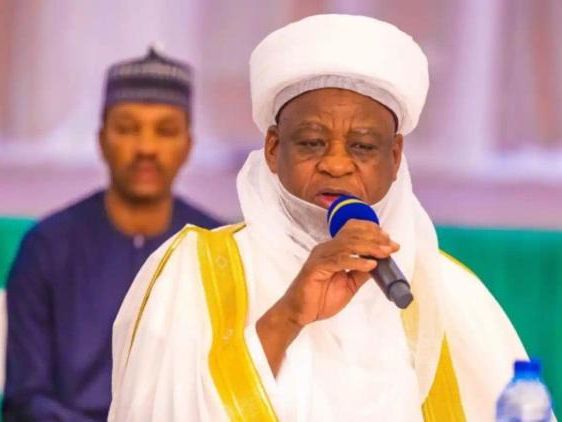
THE Sultan of Sokoto, Saad Abubakar III, has pushed back against claims of a religious agenda behind Nigeria’s insecurity, stating that Muslims are not plotting to eliminate Christians in the country.
Speaking on Wednesday at the first triannual meeting of the Nigeria Inter-Religious Council (NIREC) in Abuja, the Sultan addressed growing public suspicion and the narrative that violent attacks in parts of the country are driven by religion. The meeting brought together key religious and government figures, including Christian Association of Nigeria (CAN) President Archbishop Daniel Okoh and Secretary to the Government of the Federation George Akume.
As NIREC co-chair, the Sultan used the platform to call for a more accurate understanding of the country’s security challenges.
“Today, as I stand here, I want to affirm that Muslims are not in a hurry and are not planning anything like decimating the population of Christians in Nigeria,” he said.
Separating Crime From Religion
The Sultan’s main argument was that labeling criminals by religion distorts reality and deepens division. He warned against describing violent actors as “Muslim bandits” or “Muslim terrorists,” even when the perpetrators claim Islamic identity.
“Let us get the narrative right, it is not about religion. Let us stop bringing religion into it. Let us call them what they are, criminals. Even if someone claims to be Muslim, what they do goes against Islam,” he said.
He stressed that religious identity should not be used to define criminal behavior, noting that such framing fuels mistrust between communities and distracts from the real issue of lawlessness.
The Sultan also condemned acts of terrorism carried out in the name of religion. “Somebody can go to the market, blow himself up, kill people and shout ‘Allahu Akbar’. Yes, God is great, but you are going to hell. They will suffer for taking innocent lives,” he said.
Addressing Religious Misinformation
Beyond insecurity, the Sultan cautioned against the misuse of religious authority and knowledge. He linked some interfaith tensions to ignorance, particularly the mistaken belief that understanding Arabic automatically qualifies someone as a religious scholar.
“The fact that you understand Arabic does not make you a Sheikh. Arabic is just a language. So literacy is very important,” he said.
His comment reflects a concern that self-proclaimed religious leaders with limited knowledge are spreading interpretations that exacerbate conflict and misinformation.
The Sultan reiterated that dialogue, not suspicion, is the only sustainable way to ease religious tensions. He emphasized that genuine understanding — not mere tolerance — is needed between Nigeria’s Christian and Muslim communities.
“In NIREC, we believe in dialogue. No matter how bad things are, we believe in dialogue. When talking, you need to understand one another, not just tolerate. If you do not believe me, what else can you do? You cannot open my heart to see what is inside. We must trust one another,” he said.
The Sultan’s remarks come against the backdrop of persistent insecurity in parts of Nigeria, including banditry in the North West and communal violence in the Middle Belt. These incidents are often described in religious terms by both domestic and international observers, despite complex factors involving land disputes, poverty, and weak governance.
The issue gained international attention last year when former U.S. President Donald Trump alleged there was a “Christian genocide” in Nigeria — a claim the federal government firmly denied. The Sultan’s intervention at NIREC can be seen as part of ongoing efforts by Nigerian religious leaders to counter external narratives and promote internal cohesion.
In a country where religion and ethnicity often overlap with political and security issues, the way violence is framed shapes public perception and policy response. By urging Nigerians to treat criminals as criminals rather than as representatives of a faith, the Sultan is advocating for a shift in national discourse — one that prioritizes stability, mutual respect, and evidence over assumption.
You want to share story with us? You want to advertise with us? You need publicity for product, or service, or event? Contact us on WhatsApp +2348056718080 or email: hallowofgodministry@gmail.com


